Objects of Desire
Twice from the ashes: how Venice learned to listen
La Fenice’s brief for eye and ear, two fires, Vivaldi at the Pietà and Florian’s orchestra.

Photo Credit
Image courtesy of © Photo: Andreas Praefcke · CC BY 3.0 via Wikimedia CommonsWhy does a city of water build its finest room for sound? Perhaps because, in a city of water and stone, every note carries. La Fenice was commissioned in 1789 to please the eye and the ear, burned twice and was rebuilt twice; Vivaldi is played in the Church of the Pietà; and from April to October an orchestra sets the tempo of Piazza San Marco. Checked against the venues’ own pages in November 2026.
Built for the eye and the ear
When Venice called for designs for a new opera house on 1 November 1789, the brief asked for the theatre most satisfying to the eye and to the ear of the audience. It also asked for a water entrance on the Rio Menuo at least twenty feet wide, measured, sensibly, for the gondola. Twenty-eight architects competed; Giannantonio Selva won, and La Fenice opened on 16 May 1792, the Feast of the Sensa.
The theatre has since earned its name, the phoenix, twice. Fire destroyed it on 13 December 1836 and it was rebuilt by 1837. Fire returned on 29 January 1996, and the city rebuilt it on the motto “com’era, dov’era”, as it was, where it was, to the design of the architect Aldo Rossi. The theatre was handed back on 8 December 2003.
The 1996 rebuilding ran on five parallel worksites, with some 300 workers, restorers and decorators a day, and the Sale Apollinee, the salons that had survived the fire of 1836, were restored and rebuilt. Today Italian operas carry English surtitles above the stage, so the plot, at least, is no longer lost on visitors.
La traviata, which had its premiere here, marked the return of the opera season in November 2004. Over two centuries La Fenice has staged world premieres by Rossini, Bellini, Donizetti, Verdi, Stravinsky, Prokofiev and Britten. In a theatre built for the ear, the ear has seldom been disappointed.
La Fenice has a sister house. The Teatro Malibran in Cannaregio stands on the site of Marco Polo’s house, destroyed by fire in 1597, and opened during the Carnival of 1678; the city bought it in 1992. Opera-goers who drive get a parting gift: a ticket earns a €15 rate at the Garage San Marco in Piazzale Roma, from 2pm to 4am, while spaces last.
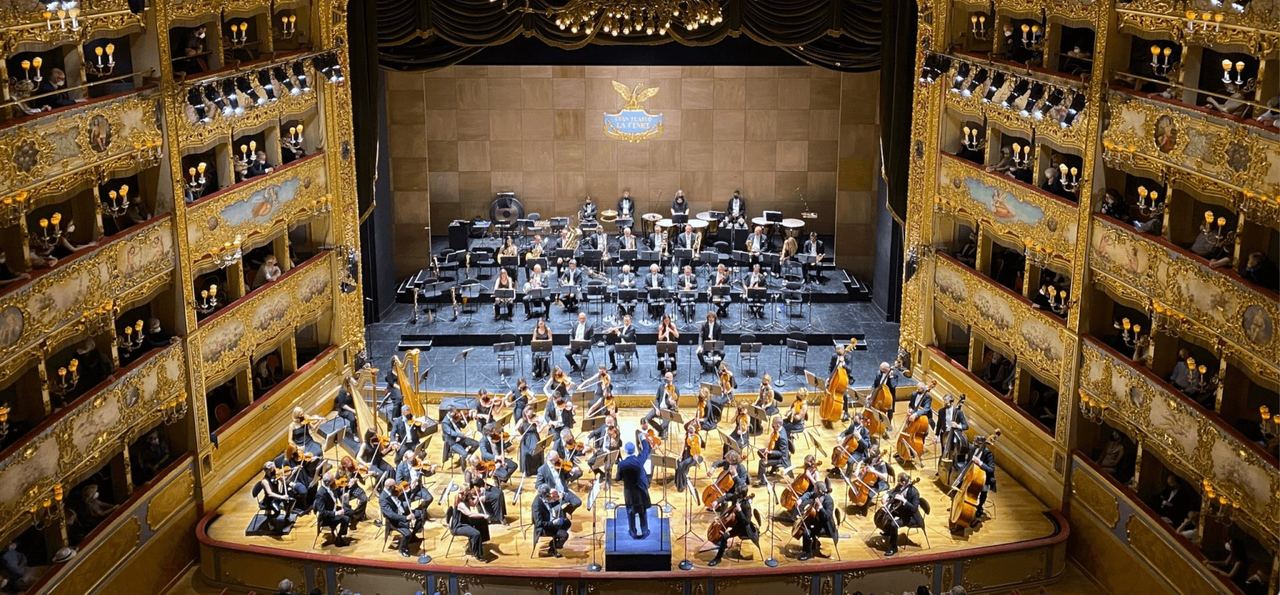
Photo Credit
Image courtesy of © Teatro La FeniceVivaldi’s city
Interpreti Veneziani have played Baroque music in Venice since 1987 and say more than 60,000 people a year come to hear them, in the Church of the Pietà and in Palazzo Zaguri at San Marco 2668, the ensemble’s home. The repertoire leans on Vivaldi, which in Venice is less a programme choice than a civic duty.
In a theatre built for the ear, the ear has seldom been disappointed.
Musica a Palazzo goes further and moves the audience. Its operas, La traviata, The Barber of Seville and Rigoletto, play in Palazzo Barbarigo Minotto on the Grand Canal by the Giglio stop, with each act staged in a different room of the palace. Seats are not numbered, the evening runs for about two hours, and the doors close at 8.30pm sharp.
At Musica a Palazzo the recommended dress is evening casual, seats are taken as the staff direct, and you follow the singers from room to room as the story moves through the palace: the only opera in town where the audience gets the exercise as well as the arias.
The orchestra in the square
Then there is the music you hear before you see it. Caffè Florian has given special attention to music since the early twentieth century, and its musicians, the café says, have kept a large repertoire for more than a century. From April to October they play on Piazza San Marco, and the café also stages concerts in its rooms, so the most famous square in Venice has a soundtrack as well as a skyline.
Our advice: book La Fenice for a repeat performance rather than an opening night if you prefer jeans to black tie, arrive early for Musica a Palazzo, and save a summer evening for Florian’s orchestra, when the piazza does the acoustics on its own. In winter, Interpreti Veneziani and the Fenice’s own concerts carry the tune.
Why it's on our list
- Built for the eye and the ear
- Vivaldi’s city
- The orchestra in the square
Location
The map comes from Google Maps, which sets its own cookies once it loads.
More in depth
 Objects of DesireOld walls, new keys: the palaces rebornPalazzo Donà Giovannelli, Palazzo Papadopoli and the Giudecca: how Venice’s palaces became hotels.
 Objects of DesireA painter in every glass: the Bellini and its relationsThe IBA’s Bellini, the Rossini, Puccini and Tintoretto, and the Venice bars that pour them.
 Objects of DesireLess parked than crouched: the electric Jaguar and the new supercarsJaguar’s Type 00 and Type 01, Ferrari’s first electric car and the record-breakers around them.