The back story
The city that walks: Venice on foot, the back story
No cars, few straight lines: how to walk Venice, from the Zattere to Tintoretto’s scuola.

Photo Credit
Image courtesy of © This Photo was taken by Wolfgang Moroder. Feel free to use my photos, but please · CC BY-SA 3.0 via Wikimedia CommonsVenice is the rare European city where walking is not a choice but the system. Its calli, fondamente and campi carry everyone who is not on a boat, and its great walks string together painters, glassmakers and an unfinished palace. Here is how those routes grew out of the city’s art and trades, and how to time them, access-fee days included, so that you walk Venice rather than queue for it.
A vocabulary for feet
Venice gives its paths their own words. A calle is a lane, a fondamenta a walk along a canal, a campo, literally a field, a square; a rio terà is a canal filled in to make a street. Learn them and the map stops looking like a dropped plate. The historic city has no cars to dodge, which leaves you free to concentrate on the bridges, the steps and the people stopping dead on them to take a photograph.
Our walks follow the grain of the place. The Zattere at sunset starts at the Punta della Dogana and runs west along the Giudecca Canal, past the Gesuati church and the San Trovaso gondola yard, with a stop for cicchetti at Cantine del Vino già Schiavi, where nobody sits down anyway.
Painters on the route
The scuole and the Frari is Venetian painting at walking pace. In the Basilica dei Frari hangs Titian’s Assunta, dated by the basilica to 1516–1518. Next door, Tintoretto worked at the Scuola Grande di San Rocco from 1564 to about 1588 on more than sixty canvases, still, the Scuola says, in their original setting: the rare walk past a painter’s life’s work where he left it. Then south to the Carmini and Tiepolo’s ceiling.
Dorsoduro’s Museum Mile runs from the Gallerie dell’Accademia past the Peggy Guggenheim Collection to the Punta della Dogana. Its middle stop is an unfinished palace, commissioned by the Venier family in 1749 and never completed, named, the museum thinks, for the stone lion heads at water level. Peggy Guggenheim bought it in July 1949 and from 1951 opened it to visitors. The Veniers ran short of palace; she found it exactly the right size.
Riva degli Schiavoni to the Biennale heads the other way, east from the Doge’s Palace along the water past the Danieli to the land gate of the Arsenale, the Republic’s shipyard, guarded by stone lions. Turn up Via Garibaldi in Castello and finish among the trees of the Giardini.
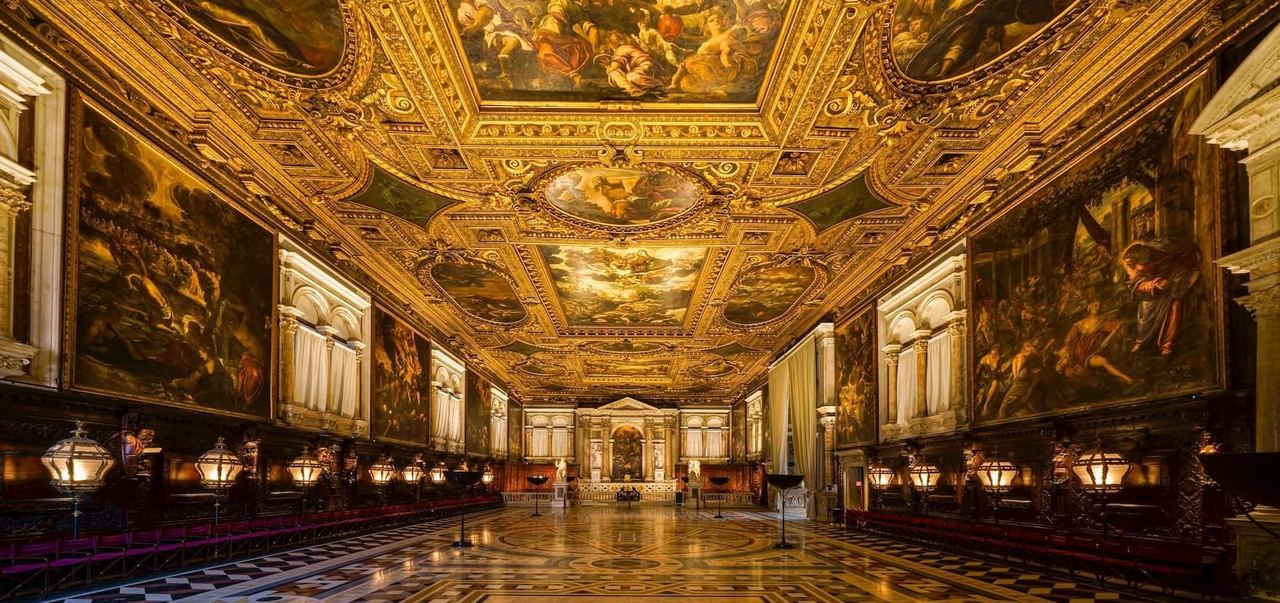
Photo Credit
Image courtesy of © Scuola Grande di San RoccoThe lagoon walks
Some walks begin on a boat. Murano’s glass fondamente owe their setting to a decision of 1291, when the Great Council moved the glass furnaces out of the city to avoid the risk of fire, as the Civic Museums’ history of glass records. Walk the Fondamenta dei Vetrai from the Colonna stop to the Museo del Vetro, founded in 1861.

Photo Credit
Image courtesy of © Peter Haas · CC BY-SA 3.0 via Wikimedia CommonsFor Burano, Mazzorbo and Torcello in a day, take the waterbus to Torcello first, for the cathedral before the crowds, then Burano for lunch and its painted streets, and cross the footbridge to Mazzorbo’s vineyard. Check ACTV routes before you go: in the lagoon the timetable is the only map that matters.
The Veniers ran short of palace; she found it exactly the right size.
The Lido by bike is the exception to every rule above: one of the few places in Venice where you can cycle. From the Santa Maria Elisabetta waterbus stop, ride down the Gran Viale to the beach and along past the Hotel Excelsior and the Palazzo del Cinema.
Timing the city
The Comune di Venezia applies its access fee, the contributo di accesso, in the historic centre on 72 days in 2027, from 26 March to 15 August, between 8.30am and 4.30pm. Who pays, who is exempt and how to register are set by the Comune: check its own pages before you travel, and plan a weekend day trip in spring or early summer with the calendar to hand.
Our advice: walk early or late. Cross the Rialto in the morning for the markets, keep the Zattere for sunset and give the lagoon a whole day, Torcello first. Then put the map away for an hour. In Venice getting lost is only ever temporary: sooner or later, every lane runs out of land.

Photo Credit
Image courtesy of © Marco Ober · CC BY-SA 4.0 via Wikimedia CommonsWhy it's on our list
- A vocabulary for feet
- Painters on the route
- The lagoon walks
- Timing the city
Location
The map comes from Google Maps, which sets its own cookies once it loads.
More in depth
 The back storyFire, silk and oarlocks: shopping in Venice, the back storyGlass since 1291, velvet on hand looms, hats made to measure: in Venice you buy from the maker.
 The back storyPiani nobili and island houses: buying in VeniceWhere people buy in Venice, and how buying works in Italy.
 Coming soonComing soon: the tech the makers have promisedOfficially announced tech, from Gemini glasses to Meta's VR specs, plus the newest arrivals.